• Skip to Navigation
  • Skip to Content
  • Skip to Footer

Center for Media at Risk

  • NEWS
  • EVENTS
  • Media
    • Infographics
    • Podcasts
    • Youtube Page
  • Takeaways
    • Reflections
    • Research
    • Reviews
    • Talks to text
  • Divider
  • ABOUT
    • Misson
    • Meet our Director
    • Engage with Us
  • People
    • FACULTY & STAFF
    • Steering Committee
    • AFFILIATES
    • Alumni
    • New Window
    • New Window

Media

  • Media
    • Podcasts
    • Infographics
    • Videos
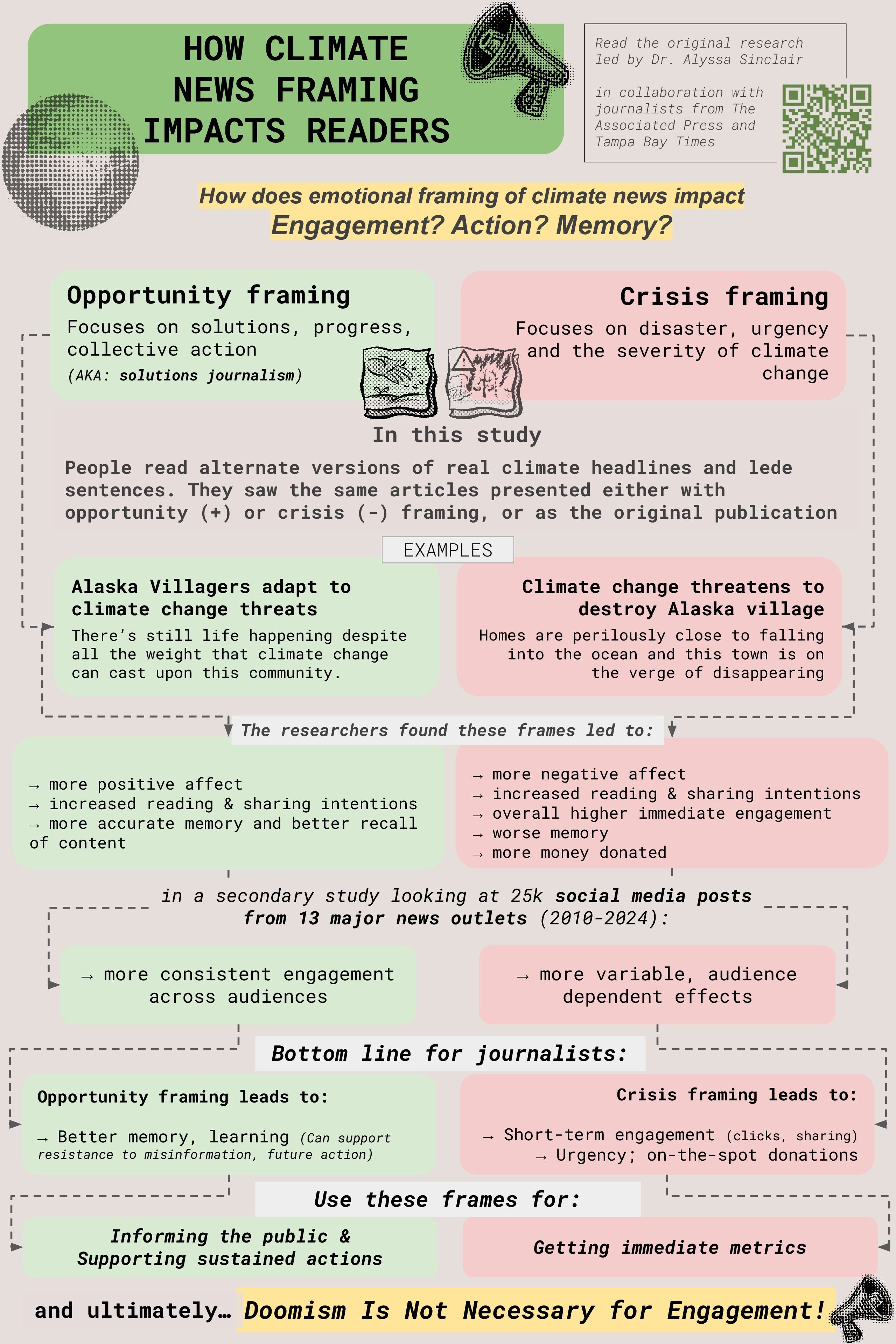
How Climate News Framing Impacts Readers
infographics

How Climate News Framing Impacts Readers

  • March 2, 2026
View How Climate News Framing Impacts Readers
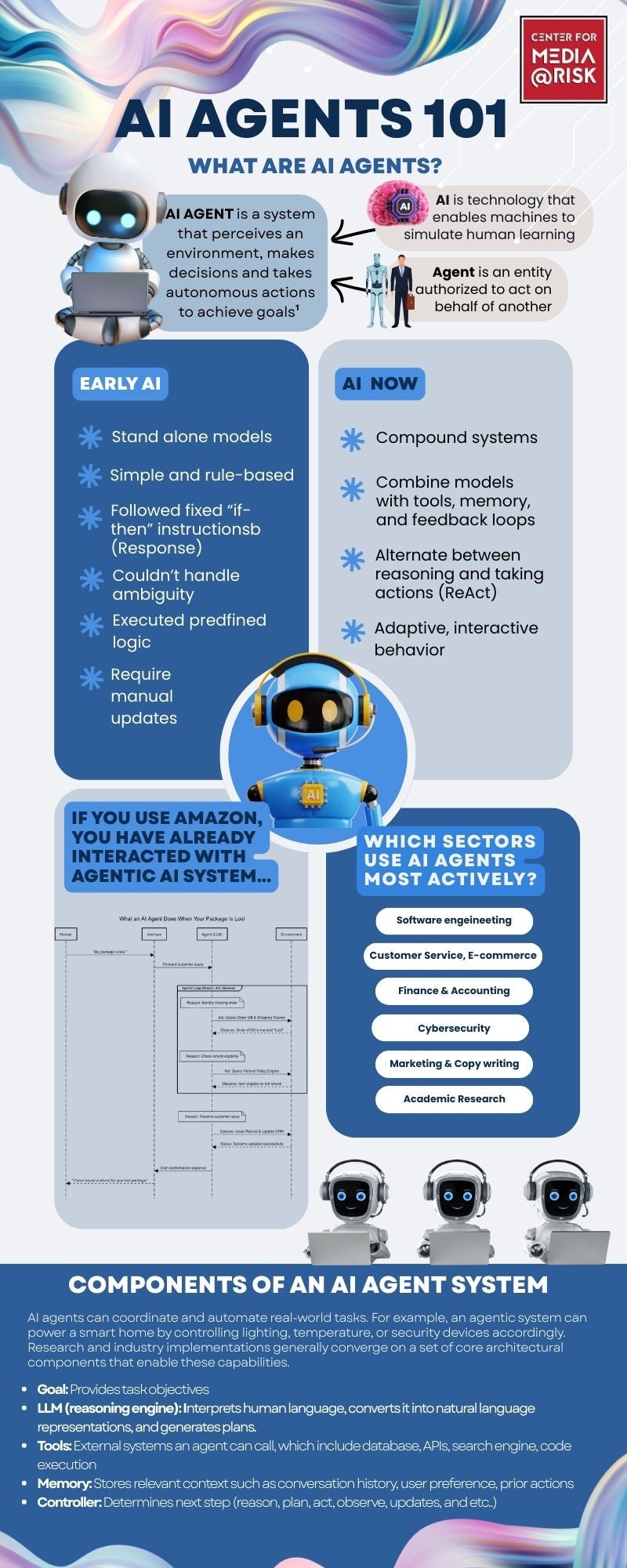
Infographic titled “AI Agents 101” from the Center for Media at Risk. At the top, colorful abstract waves frame the header. Below, cartoon-style robot illustrations appear throughout the design. A section labeled “What Are AI Agents?” explains that an AI agent is a system that perceives an environment, makes decisions, and takes autonomous actions to achieve goals. Additional text defines agents as technology that simulates human learning and as entities that act on behalf of another. Two side-by-side boxes compare Early AI and AI Now. Early AI: stand-alone models; simple rule‑based systems; followed fixed “if‑then” instructions; could not handle ambiguity; used predefined logic; required manual updates. AI Now: compound systems; combine models with tools, memory, and feedback loops; alternate between reasoning (Think) and taking actions (React); display adaptive, interactive behavior. A mid-page section notes that using Amazon services means interacting with agentic AI systems. A small technical diagram appears beside this text. Another box lists sectors that use AI agents most actively, including: software engineering; customer service and e‑commerce; finance and accounting; cybersecurity; marketing and copywriting; academic research. At the bottom, a section labeled “Components of an AI Agent System” explains that AI agents coordinate real‑world tasks and may include goal‑directed technologies, large language models, tools (such as calculators, web search, or databases), and memory systems. Small robot illustrations line the bottom of the graphic.
AI Agents 101
infographics

AI Agents 101

  • March 2, 2026
View AI Agents 101
Journalism in Africa: What the Global North Can Learn from the Global South
podcasts

Journalism in Africa: What the Global North Can Learn from the Global South

  • February 20, 2026
View Journalism in Africa: What the Global North Can Learn from the Global South
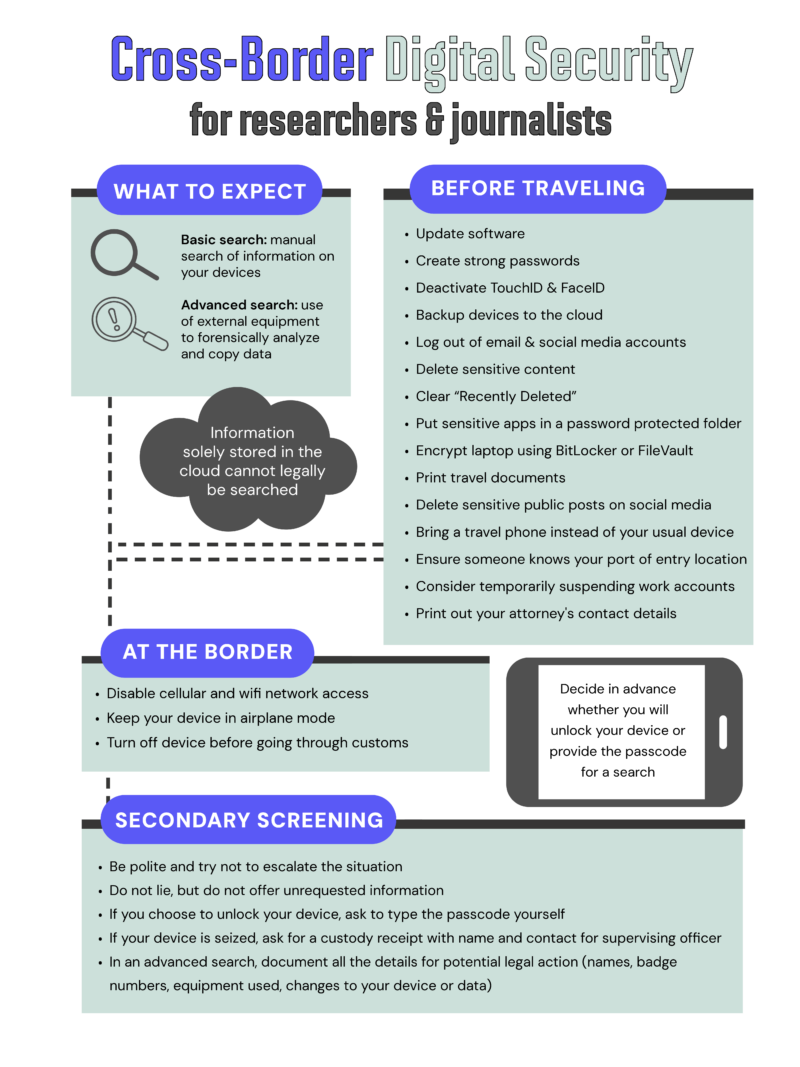
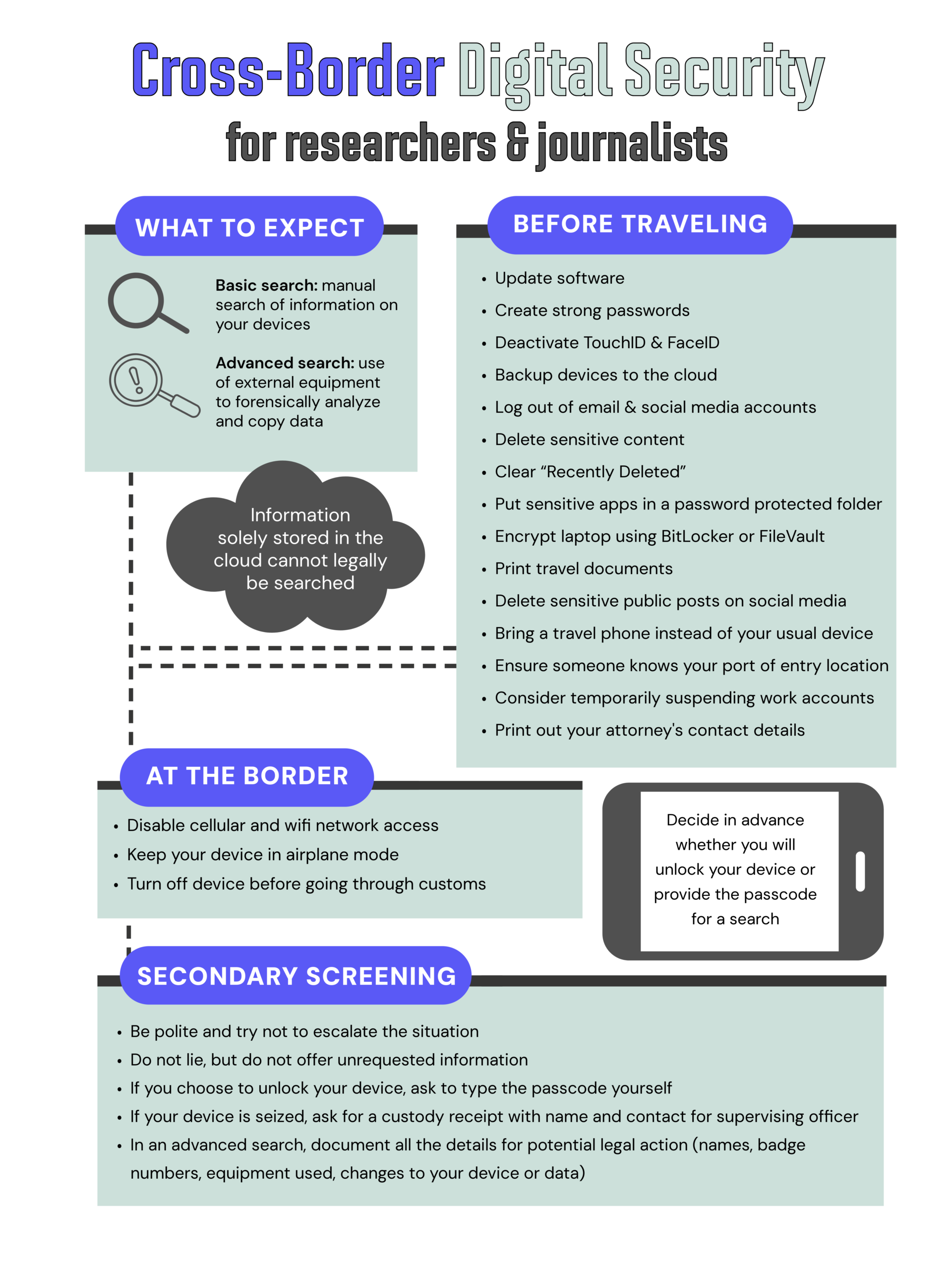
A vertically oriented infographic titled “Cross‑Border Digital Security for researchers & journalists.” It is divided into four sections: What to Expect, Before Traveling, At the Border, and Secondary Screening. The design uses teal, purple, black, and grey accents, with icons for search, devices, and borders. Section 1: What to Expect A box with two subsections: Basic search: Manual search of information on your devices. Advanced search: Use of external equipment to forensically analyze and copy data. A dotted line surrounds a grey bubble stating: “Information solely stored in the cloud cannot legally be searched.” Section 2: Before Traveling A bulleted list: Update software Create strong passwords Deactivate TouchID & FaceID Backup devices to the cloud Log out of email & social media accounts Delete sensitive content Clear “Recently Deleted” Put sensitive apps in a password‑protected folder Encrypt laptop using BitLocker or FileVault Print travel documents Delete sensitive public posts on social media Bring a travel phone instead of your usual device Ensure someone knows your port‑of‑entry location Consider temporarily suspending work accounts Print out your attorney’s contact details Section 3: At the Border Guidance for device handling: Disable cellular and Wi‑Fi network access Keep your device in airplane mode Turn off device before going through customs To the right is an illustration of a smartphone and a note saying: “Decide in advance whether you will unlock your device or provide the passcode for a search.” Section 4: Secondary Screening A bulleted list: Be polite and try not to escalate the situation Do not lie, but do not offer unrequested information If you choose to unlock your device, ask to type the passcode yourself If your device is seized, ask for a custody receipt with name and contact for the supervising officer In an advanced search, document all details for potential legal action (names, badge numbers, equipment used, changes to your device or data)
Cross-Border Digital Security for researchers and journalists
infographics

Cross-Border Digital Security for researchers and journalists

  • February 10, 2026
View Cross-Border Digital Security for researchers and journalists
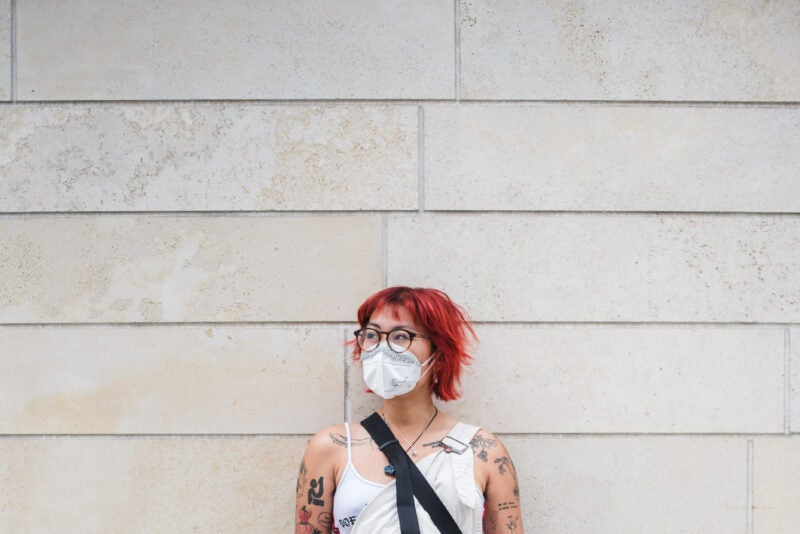
Image of James Salanga standing in front of a white wooden wall with red hair, glasses, and wearing a white mask. They are wearing a white top with a black strap visible, perhaps from a cross body bag. They are looking away from the camera at an angle. Photo by Abby Mahler.
Disability, Solidarity and Possibility
podcasts

Disability, Solidarity and Possibility

  • May 13, 2025
View Disability, Solidarity and Possibility
Vibrant and colorful Entrace Gate to Chinatown shot at an angle in Philadelphia, PA, USA, on a sunny Day - Backlight from Sun with Lens Flare; Letters translate "Philadelphia Chinatown"
From Campus to Chinatown
podcasts

From Campus to Chinatown

  • May 9, 2025
View From Campus to Chinatown
Book cover for graphic novel, "you must take part in the revolution". Title in yellow lettering on black background. Red flames and hands holding bottles in the foreground.
You Must Take Part in Revolution: with Badiucao & Melissa Chan
podcasts

You Must Take Part in Revolution: with Badiucao & Melissa Chan

  • May 2, 2025
View You Must Take Part in Revolution: with Badiucao & Melissa Chan
A person is sitting on a chair and painting on a canvas placed on an easel. The scene is set in an art studio with abstract decor, including a framed picture on the wall, books, and plants. The color scheme is predominantly blue and purple with some red accents.
Artist Precarity in Philadelphia
infographics

Artist Precarity in Philadelphia

  • December 12, 2024
View Artist Precarity in Philadelphia
Journalists holding microphone and dictaphone, interviewing speaker.
Racial Capitalism, Journalism History, Liberated Futures: A Conversation with Joseph Torres
podcasts

Racial Capitalism, Journalism History, Liberated Futures: A Conversation with Joseph Torres

  • December 10, 2024
View Racial Capitalism, Journalism History, Liberated Futures: A Conversation with Joseph Torres
TItle: center for media at risk statement on press freedom and the 2024 presidential election
Center for Media at Risk Statement on Press Freedom and the 2024 Presidential Election

Center for Media at Risk Statement on Press Freedom and the 2024 Presidential Election

  • November 6, 2024
View Center for Media at Risk Statement on Press Freedom and the 2024 Presidential Election
1 2 3 … 5 Next

Center for Media at Risk

Annenberg School for Communication
3620 Walnut Street
Philadelphia, PA 19104

Email: media.risk@asc.upenn.edu

    • New Window
    • New Window

The Center for Media at Risk is dedicated to identifying threats to media and strategizing in response to conditions that undermine free and critical media practice worldwide.

Center for Media at Risk
Copyright © 2026 Center for Media at Risk. All rights reserved.
WordPress Theme by FORQY
  • Privacy Policy
  • Report Accessibility Issues and Get Help
    • New Window
    • New Window
Back to Top

Search

Center for Media at Risk