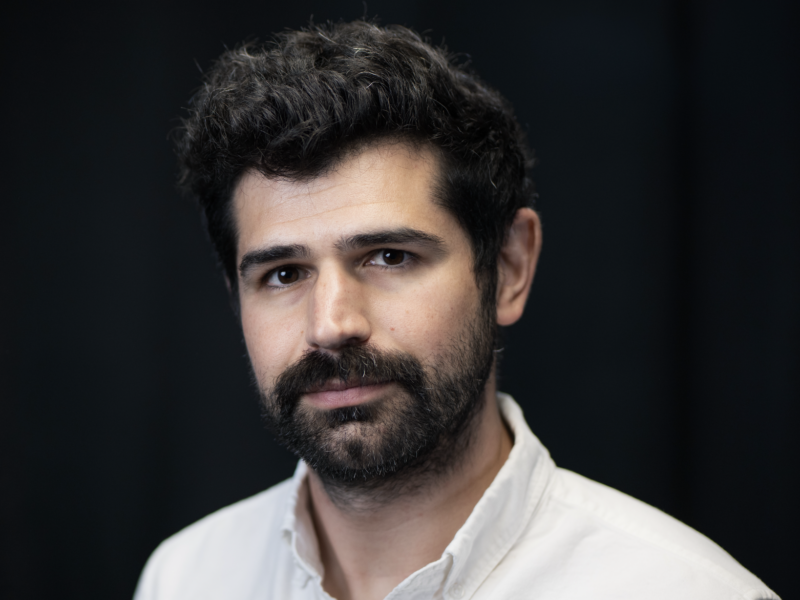
In this episode of Media at Risk, joint doctoral candidate Natasha Williams speaks with a courageous group of global media makers living in exile. Hailing from China, El Salvador and Palestine, Kasim Kashgar, Mariana Belloso and Youmna El Sayed discuss how their media praxis talks back to oppression and imagines liberatory futures. In conversation, we hear the stories of their forced displacement and learn about the conditions of violence and occupation that they escaped. By bringing together journalists in exile from varied contexts to discuss how they work to bridge the time and space which now separates them from their homelands, this conversation challenges us to rethink our approach to media, space and nation.
Royalty Free Music from Bensound by Diffie Bosman
Kasim Kashgar is a Uyghur journalist and former reporter for Voice of America, with expertise in covering China, human rights, and diasporic communities. From 2019 to 2025, he produced over 300 multilingual news reports for VOA, focusing on human rights in China, U.S.–China relations and the global Uyghur diaspora. Prior to seeking asylum in the United States in 2017, he was a prominent English educator and founder of one of the largest Uyghur-owned language schools in the Xinjiang Uyghur Autonomous Region. He is completing a memoir exploring themes of exile, resilience and freedom of expression, and is also leading the launch of Uyghur Monitor, an independent nonprofit media initiative committed to democracy, accountability and independent reporting on Uyghur issues. His work has appeared on international media platforms, and he was named a 2025 Kiplinger Fellow in AI and Journalism.
Mariana Belloso is a Salvadoran journalist, editor and media analyst with more than two decades of experience in economic reporting across print, radio and digital platforms. She has led the economic sections of two of El Salvador’s leading newspapers, Diario El Mundo and La Prensa Gráfica. She also served as general editor of Alharaca, an independent media outlet. Her expertise spans fiscal policy, finance and international trade, and she has covered multilateral negotiations and global economic trends. Forced into exile in the United States after facing digital surveillance and harassment for her critical reporting on government policies, Mariana now coordinates the Latin American Network for Journalism in Exile, a pioneering initiative of the Inter American Press Association. Through her work, she advocates for the rights and professional continuity of journalists displaced by authoritarian regimes and violence, building support systems and employment opportunities for media professionals in exile.
Youmna El Sayed is an internationally recognized journalist and public speaker, who served as the Al Jazeera English Correspondent in the Gaza Strip. With over ten years of experience reporting from the frontlines of conflict, she has worked with numerous leading international media outlets and received several international awards and honors for her fearless journalism and advocacy for human rights. Specializing in stories of war, displacement, identity and human dignity, she has consistently brought to global attention the untold human narratives of those living under siege, occupation and conflict. Through her work, her core mission is to be a voice for the voiceless, seeking not only to inform but to humanize and empower, shedding light on stories too often silenced or overlooked.
Natasha Williams is a joint doctoral candidate in Communication and Political Science at the University of Pennsylvania and is a critical scholar of digital media and international relations. Her research is broadly interested in the influence of social media, content creators and digital journalism on public understandings of global politics. At Penn, Williams is a Doctoral Fellow with the Center for Media at Risk, the Center for Advanced Research in Global Communication, and the Politics, Identity and Communication Lab. She received a Bachelor of Arts in International Relations and Economics summa cum laude from New York University in 2019, a Master of Arts in Communication from the Annenberg School in 2024 and a Master of Arts in Political Science from the School of Arts & Sciences in 2025. She is also a proud first-gen college student and educator.
Transcript
Natasha: Welcome to Media Risk, a podcast from the Center for Media at Risk at the Annenberg School for Communication at the University of Pennsylvania. My name is Natasha Williams, and I am a joint doctoral student here at Annenberg and a member of the Center’s steering committee. Today’s episode focuses on the experiences of journalists and media practitioners currently living in exile. Our guests today come from around the world, respectively, from El Salvador, China and Palestine.
In our discussion, we’ll hear from them about how they bridge the time and space separating them from their homelands, and how their media praxis talks back to oppression and imagines liberatory futures. In light of 2024 being labeled by the Committee to Protect Journalists as the deadliest year on record for journalists in modern history, shining light on the voices of journalists in exile, coming from varied contexts of violence and occupation, is thus more critical than ever. And will challenge us to rethink our approach to media, space and nation. With that, I’m very pleased to introduce our incredible set of guests here today.
First, we have Mariana Belloso, a Salvadorian journalist, editor and media analyst with more than two decades of experience in economic reporting across print, radio and digital platforms. She has led the economic sections of two of El Salvador’s leading newspapers, Diario El Mundo and La Prensa Gráfica. She also served as general editor of Al Haraca, an independent media outlet. Her expertise spans fiscal policy, finance and international trade, and she has covered multilateral negotiations and global economic trends.
Next, we have Kasim Kashgar, a Uyghur journalist and former reporter for Voice of America with expertise in covering China, human rights and diasporic communities. From 2019 to 2025, he produced over 300 multilingual news reports for Voice of America, focusing on human rights in China, U.S.-China relations and the global Uyghur diaspora. Prior to seeking asylum in the United States in 2017, he was a prominent English educator and founder of one of the largest Uyghur owned language schools in the Xinjiang Uyghur Autonomous Region.
Finally, we have Youmna El Sayed, an internationally recognized journalist and public speaker who served as the Al Jazeera English correspondent in the Gaza Strip. With over ten years of experience reporting from the frontlines of conflict, she has worked with numerous leading international media outlets. Specializing in stories of war, displacement, identity and human dignity, she has consistently brought to global attention the untold human narratives of those living under siege, occupation and conflict. Thank you all so much for being here today.
Kasim, Mariana, Youmna: Thank you, Natasha.
Natasha: To begin, I’d like to ask you to help our listeners better understand the nature of your circumstances. Particularly, I’m hoping that you can elaborate for us what it means to be both a journalist and a media maker in exile. Also, if you can tell us more about the conditions that led to the circumstances of your forced displacement.
Mariana: For most of us, being in exile is being able to keep your voice. It’s the freedom to continue doing your job, but at a high cost. You need to flee your country, your family, your roots, your networks, your job, your stability. You come to a foreign country with a foreign language and you need to start all over again. And that doesn’t guarantee that you’re going to be safe, but it gives you space and it gives you the opportunity to say things that in your country, you are no longer able to say.
In my particular case, I was a respected voice on economic topics and financial topics in my country. I was invited very often to radio and TV interviews to explain economic topics and to explain the economic decisions of the governments. I was doing that with governments from the left and the right, and I had criticism for that from the governments, but not to the point to have to leave my country. Until 2019, with the regime of Nayib Bukele.
He started harassing me from his Twitter account, now X, then it was called Twitter. He was harassing me and he said that I wanted him to fail in his security plan and that I was on the side of the gang members. That’s something that’s very dangerous for someone to say, because at that time in El Salvador, you could be a victim of the gang groups, but also a victim from other criminal groups that used to kill gang members. So, for someone, for the president of your country to say that you were on the side of the gang, it was a serious accusation. So, the harassment continued from 2019, 2020. 2021, I tried to resist. I was fired from work because of the harassment of the government, but at the end of 2021, I found out that I was being spied on with the spyware Pegasus. For me, that was the end. I needed to leave the country. I thought it was going to be something temporary, a couple of months. But then when I came to the United States and I was preparing to sue the government because of the spyware, then they changed the law. Now it’s legal for the government to spy on citizens in El Salvador.
Kasim: So, to me, being a journalist in exile means asking the essential questions in freedom and finding responses and communicating answers to the public for the education of the public. That’s what it means. And what led me to be in exile, the circumstances. I left where I used to live, now in China, it’s what the Uyghurs call East Turkestan, and China named it as Xinjiang Uyghur Autonomous Region. It’s one sixth of the total landmass of now the People’s Republic of China. The majority are still the Uyghurs. I had a pretty successful life there. I was leading a language school I founded on my own. And finally, I got to a place where I was titled as a national Uyghur young model entrepreneur in Beijing.
But on the other hand, the Chinese authorities actually increased the repression. Daily disappearances of Uyghurs around me were going on while I was being staged on the propaganda stage, and eventually I was struggling to decide whether to leave and be a voice to the voiceless or stay and try my best to keep that propaganda stage. But eventually I decided to leave, leave everything and be the voice of the people. And I made the right decision. Even though life in exile is a different one with its own struggles.
Youmna: Well, for me, being a journalist or a media maker in exile is being a journalist anywhere in the world. But in my case, I think it was a little bit different because I didn’t expect that I would be in exile. Like suddenly I would have to leave the Gaza Strip to escape a genocide, or because I fear for the life of my children. I left under very immense conditions at the end of 2023, and I was basically just trying to save their life from being killed. So, it wasn’t a decision that I made; I basically had to weigh between being a mother and a journalist.
It’s very complicated for me because I’m also an Egyptian, but I still feel that I’m in exile in Egypt because I’m Palestinian. I’m part of the Palestinian syndicate, but I’m not part of the Egyptian journalism syndicate. I’m treated as a Palestinian journalist who does not have any rights to work or report from Egypt, regardless of my national Egyptian ID. My husband is Palestinian and my children are Palestinians, and speaking out in Egypt would jeopardize their safety. And I’m under this category where another 180 Palestinian journalists are, where we all have to be quiet. For me, I don’t think this was an option because I already came out of Gaza feeling that immense feeling of survival guilt. That took over me for quite a long time after I escaped. And I felt like the only way I could get over it was to continue speaking out about the genocide that is happening, that is ongoing, and that’s why I had to keep on reporting.
I’m not allowed, as an Al Jazeera correspondent, to report from Egypt because Al Jazeera is banned. So, for the past, over ten years of my life, I’ve always been a TV correspondent or a TV journalist. And I turned to print where I can write articles in UK newspapers about the ongoing genocide, about also the Palestinians in Egypt, whether those are citizens in exile or journalists living in exile. I use my ability to write to expose these realities because I know that a lot of my colleagues, a lot of my friends tell me that this could lead to something that’s not really nice in Egypt, but I believe that that’s what a journalist is. You can’t just be quiet because otherwise, I mean, a journalist, this is who you are. This is what you do. You are a firsthand witness. You are a reporter. You’re a voice for people who do not have the privilege to speak out for themselves. And this is what I’ve chosen to do. So, this is what I continue doing until now.
Natasha: One of your last comments got me thinking about something I wanted to ask you all about. In thinking about the evolution of your journalistic praxis since your forced exile from your homes, I’m wondering if you can speak more about both the opportunities that perhaps being abroad has potentially lent to your ability to speak on things that are happening back home, but also how your exile has also contributed to the continuation of some of these precarities and potentially the opening of new challenges in your work.
Mariana: Well, doing journalism from exile, it’s hard. It’s really, really hard. In my experience, it’s harder when you are the leader of a team and the team is still in the country, in your country, that’s really hard. When you are trying to make investigative journalism from exile, you depend on your sources. So, for me, the key is my sources. I’m constantly talking to people inside El Salvador through secure channels about what is happening and all the things that you don’t see in the traditional media there, but it’s happening. You talk to the families of the people that have been imprisoned by the government just for being there or being poor. You know, we already have almost three years of exemption state in El Salvador, and they are just imprisoning people just because. We have now around 100,000 people in prison with no trial. So, you talk to their families, you talk to the organizations that are working with them, and you talk to the lawyers. You talk to the people that are in the field. And these people want to talk, but they don’t have someone that they can trust or that can report what is happening inside the country. So, for me, the key is to maintain your sources. To look for new sources, but also to do the best work you can do. Do honest work, do quality journalism. Because if you do that, people will see your work and people will want to talk to you wherever you are.
Kasim: For me, it’s the freedom of oppression when you are in exile in the US, compared to if someone who is in China or in East Turkestan. That person doing journalism is nonexistent. You can’t do it. You’ll be in prison. So now in exile, you can do it freely. But then it comes with its own challenges and threats. Threats to your family, friends and colleagues, like past colleagues, people who you had connection with in the past. And any news that you put out as a journalist is investigated by the Chinese Communist Party state, and then they try to find out who are your sources inside. And then they, the police or the secret police, would visit them, would arrest them, would interrogate them and anything could happen to them, that is the dangerous part. And then the challenge becomes, how could you put out real journalism, facts without endangering your sources inside. That has been the challenge throughout the years. And it’s still the challenge.
Natasha: I’m wondering to hear from all of you, what can we ask and demand of Western institutions, journalists, media makers, public figures, scholars to do better?
Mariana: We cannot be echo chambers. We cannot just repeat the official version. As my colleague said, the governments are so good at inviting people to go out and repeat their version of things, and they are not taking into account other voices or the context. If they dig up a little more, they would find what is really happening. I get frustrated every time I see reports of El Salvador mega jail, CECOT. The government doesn’t allow Salvadorian journalists to go there. It’s forbidden. But they would invite international journalists to go. And then they write stories about this mega jail, this big jail, the biggest jail in Latin America. And they put photographs of these people with tattoos and gang names on their skin. And that’s not the reality.
The reality is that that same government made deals with gang members, made deals with Salvadorian lives, to sell internationally this version of the most secure country in the world. They have imprisoned hundreds of thousands of innocent people, and they are not in CECOT. They are in other jails where you don’t take the international reporters. You don’t take the influencers there. And of course, you don’t allow the independent media to go there. Because in that jail the people are being tortured, they are being killed. You say something, and they just disappear in the system. They get arrested and you don’t know about them anymore. That’s what’s happening. But that’s not what the international media or the influencers are saying. They just go to CECOT, they do their tour and they write about it. And that is happening in Gaza. That is happening in China. We cannot be echo chambers. We cannot just go and repeat the official version. We need to dig. We need to make our job as journalists about asking, questioning and doing research. Previously, during a report and after a report so we can be more honest with the product we are delivering to our audiences.
Youmna: What we need today, honestly, is a system that protects journalists. That protects newsrooms to continue to operate independently with honesty, with integrity. We need laws to protect our journalistic organizations like the CPJ, like the IFJ. They feel that they’re helpless for their journalists. They’re not allowed, they’re not able to protect their journalists. They’re not able to protect their journalists from being detained, from being interrogated, from being killed, from being banned. The international community, the governments of the world are taking away their power bit by bit. It’s causing fear among the journalists of the world. It’s causing us to feel that we don’t have any kind of protection anymore to go on with our jobs. So sometimes you’d be fearless because you have that passion in you to be a journalist, to continue reporting. But when that passion is going to jeopardize your loved ones, you’re going to think twice, right? And it’s not fair. It’s not fair to be hunted because you’re a journalist.
Natasha: Thank you. Youmna, your point on this hope to be fearless in one’s reporting inspires me to want to close us out on an optimistic note. I want to ask all of you to reflect on what it is that keeps you motivated to continue your work in spite of all these risks that we’ve talked about today. And also points of hope that you have for the future.
Mariana: For me, it has been that if I stop doing journalism, then these people won. I know a lot of my colleagues have taken the decision to stop doing journalism out of all this harassment and the risks, and I respect that. And not everyone has the opportunity to go out, to keep doing this in safer circumstances. But for me, it’s not giving up. For me, it’s not letting them win because that’s what they want to do.
Kasim: Well, to me, keeping doing journalism means it’s not turning away from the struggles of the unheard. And also, not becoming indifferent to those who are actually in danger and who are being abused. And then keeping my conscience alive. Reporting is, at the highest, it’s making my life meaningful. And what brings hope for the future is in the younger generation. It’s while I’m reporting that I can reach more and more younger generations who seek real information or factual information or what can be called as truth, then I think I’ve achieved.
Youmna: Many times, especially during this genocide. I just felt like I can’t go on anymore. I can’t go on physically. I can’t go on mentally. I can’t process what is happening around me. And every single time I felt like I just want to break down, give up, just stop even going out to report, I just couldn’t because the suffering around me was immense. It was unbearable. And the fact that I asked myself, how can this world be so silent about what is happening to us? How can they just be okay with turning a blind eye and a deaf ear towards our suffering like that? How can they just abandon us? Choose to abandon us so easily like that?
Especially at the first three months. It was three months where I felt that we were just speaking into the void. Nobody was listening. Nobody was aware, not even people around the world. And I believe that people were not aware because journalists were not reporting what’s happening, like it was happening. It did not start small. It did not start light. It started with total destruction. It started with the heaviest pace. And it was just incomprehensible for me to see it going on with this pace and this intensity and not being reported. And so, the suffering of the people is what kept me going. Because I know that I always told myself, if I did not speak about them, how are they going to be heard?
Natasha: Thank you all so very much for such an incredibly rich and thought-provoking conversation. I think we’ve gained a lot from bringing all of your voices together in one space. It’s been such a pleasure and privilege to be in community and conversation with you all today. So, with that, thank you all for listening. This has been Media at Risk, a podcast at the Annenberg School for Communication at the University of Pennsylvania.