Cross-Border Digital Security for researchers and journalists

International travel increasingly poses challenges for researchers and journalists trying to keep their data secure during border crossings. This infographic offers practical, step-by-step guidance aimed at reducing data security risks when traveling across international borders. U.S. Customs and Border Protection (C.B.P) agents have broad authority to look through travelers’ phones, laptops and other electronic devices for both citizens and non-citizens. Use this infographic to prepare before travel, at the border and during secondary screening.
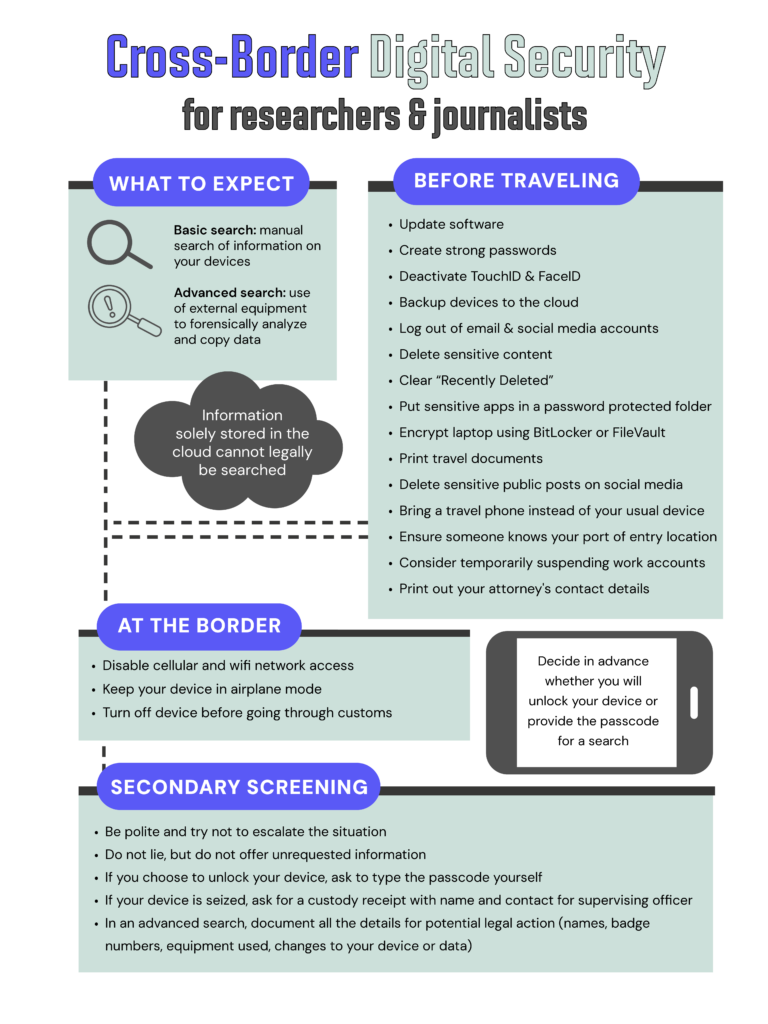
A vertically oriented infographic titled “Cross‑Border Digital Security for researchers & journalists.” It is divided into four sections: What to Expect, Before Traveling, At the Border, and Secondary Screening. The design uses teal, purple, black, and grey accents, with icons for search, devices, and borders.
Section 1: What to Expect
A box with two subsections:

Basic search: Manual search of information on your devices.
Advanced search: Use of external equipment to forensically analyze and copy data.
A dotted line surrounds a grey bubble stating: “Information solely stored in the cloud cannot legally be searched.”

Section 2: Before Traveling
A bulleted list:

Update software
Create strong passwords
Deactivate TouchID & FaceID
Backup devices to the cloud
Log out of email & social media accounts
Delete sensitive content
Clear “Recently Deleted”
Put sensitive apps in a password‑protected folder
Encrypt laptop using BitLocker or FileVault
Print travel documents
Delete sensitive public posts on social media
Bring a travel phone instead of your usual device
Ensure someone knows your port‑of‑entry location
Consider temporarily suspending work accounts
Print out your attorney’s contact details

Section 3: At the Border
Guidance for device handling:

Disable cellular and Wi‑Fi network access
Keep your device in airplane mode
Turn off device before going through customs

To the right is an illustration of a smartphone and a note saying:
“Decide in advance whether you will unlock your device or provide the passcode for a search.”
Section 4: Secondary Screening
A bulleted list:

Be polite and try not to escalate the situation
Do not lie, but do not offer unrequested information
If you choose to unlock your device, ask to type the passcode yourself
If your device is seized, ask for a custody receipt with name and contact for the supervising officer
In an advanced search, document all details for potential legal action (names, badge numbers, equipment used, changes to your device or data)

Ran Wang is a Center for Media at Risk steering committee member and a joint doctoral student at the Annenberg School for Communication and the Department of Sociology. Her research focuses on the interaction between censorship and digital culture, particularly cultural production.